1902 Encyclopedia > John Ramsay McCulloch
John Ramsay McCulloch
Writer on political economy and statistics
(1779-1864)
JOHN RAMSAY McCULLOCH (1779-1864), a distinguished writer on political economy and statistics, was born on 1st March 1779, at Whithorn in Wigtownshire. His family belonged to the class of "statesmen," or small landed proprietors. Having received his early education from his maternal grandfather, a Scotch clergyman, he came to Edinburgh, and was for some time employed there as a clerk in the office of a writer to the signet. But, the Scotsman newspaper having been established at the beginning of 1817, McCulloch sent a contribution to the fourth number, the merit of which was at once recognized ; he soon became connected with the management of the paper, and during 1818 and 1819 acted as editor. Most of his articles in the Scotsman related to questions of political economy, and he delivered lectures in Edinburgh on that science. He now also began to write on subjects of the same class in the Edinburgh Review, his first contribution to that periodical being an article on Ricardo's Principles of Political Economy in 1818.
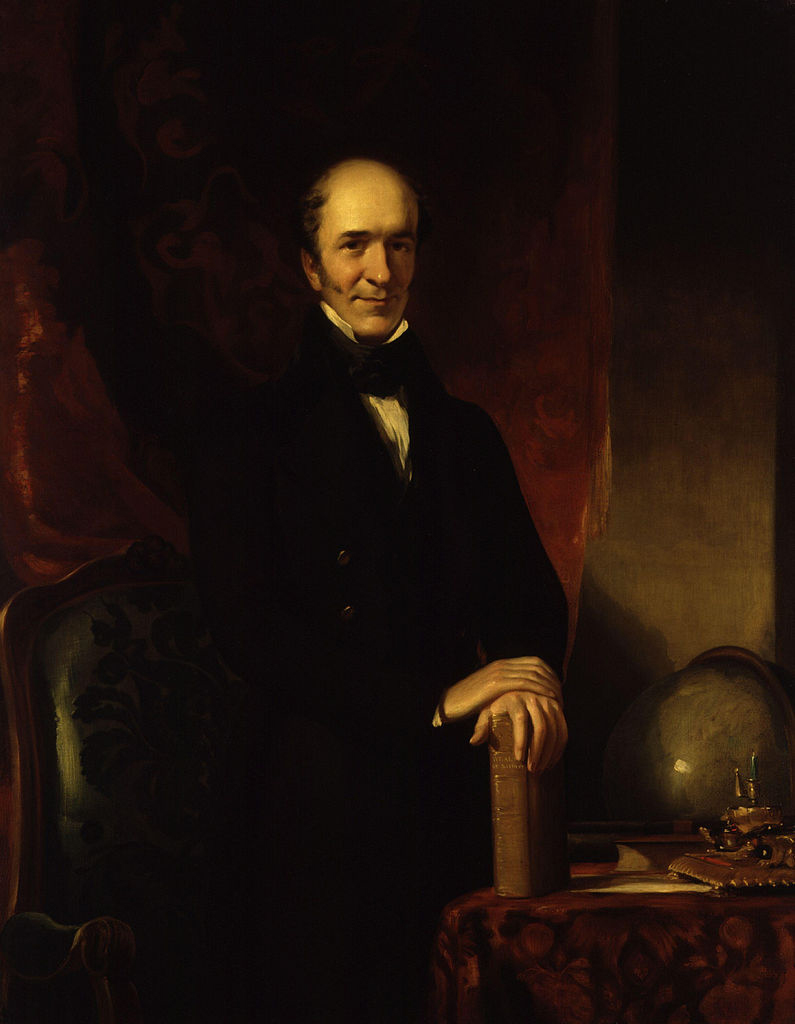
John Ramsay McCulloch.
Date: Unknown. Artist: Sir Daniel Macnee (died 1882). Current Location: National Portrait Gallery, London.
The painting shows McCulloch holding a volume of Adam Smith's Wealth of Nations (McCulloch issued several standard editions of that work).
Within the next few years he gave both public lectures and private instruction in London on political economy, and had amongst his hearers or pupils many persons of high social position, and some who were important in the political world. In 1823 he was chosen to fill the lectureship established by subscription in honour of the memory of Ricardo. A movement was set on foot in 1825 by Jeffrey and others to induce the Government to found in the university of Edinburgh a chair of political economy, separate from that of moral philosophy, the intention being to obtain the appointment for McCulloch. This project fell to the ground ; but in 1828 he was made professor of political economy in the London University. He then fixed his residence permanently in London, where he continued his literary work, being now one of the regular writers in the Edinburgh Review. Indeed it appears from a letter of his to Macvey Napier in 1830 that he regarded himself, though Napier did not admit the justice of the claim, as entitled to be the sole contributor of economical articles to the Review. In 1838 he was appointed comptroller of Her Majesty's Stationery Office; the duties of this position, which he held till his death, he discharged with conscientious fidelity, and introduced important reforms in the management of the department. Sir Robert Peel, in recognition of the services he had rendered to political science, conferred on him a literary pension of £200 per annum. He was elected a foreign associate of the Institute of France (Academy of Moral and Political Sciences). He died, after a short illness, on 11th November 1864, in the seventy-sixth year of his age. To his personal character and social qualities very favourable testimony is borne by those who knew him best. In general politics he always remained a Whig pure and simple; though he was in intimate relations with James Mill and his circle, he never shared the Radical opinions of that group.
McCulloch cannot be regarded as an original thinker on political economy. He did not contribute any new ideas to that science, or introduce any noteworthy correction of the views, either as to method or doctrine, generally accepted by the dominant school of his day. But the work he did must be pronounced, in relation to the wants of his time, a very valuable one. It was at an important crisis that he appeared in the field of economical discussion. The principles of free trade had been powerfully asserted before the public in the celebrated petition of the merchants of London, drawn up by Mr Tooke and presented to parliament by Mr Alexander Baring in 1820. Political economy, to which the bullion controversy had previously attracted much attention, was more and more engaging the minds of political writers and of statesmen. But the new views had to encounter fierce and sometimes unscrupulous opposition. The Edinburgh Review was the principal organ of the reformers, and was maintaining, when McCulloch became a writer in it, an energetic warfare against the policy founded on the mercantile theory of wealth. Naturally endowed with strong sense and sagacity, and possessing a rare capacity for arduous and prolonged mental exertion, he threw himself, with the ardour of conviction, into the great struggle. There can be no doubt that his labours on the whole contributed largely to the diffusion of just ideas on the economic questions then under debate, and to the right direction of the national legislation with respect to them. It must at the same time be admitted that his treatment of the subjects with which he dealt is not marked by any special breadth or elevation. He adopted too hastily the theoretic exaggerations of some of Smith's successors, and exhibited in full measure their habitual deadness, in the study of social questions, to all but material considerations. In his evidence before the parliamentary committee on the state of Ireland in 1825 he stated opinions, afterwards more fully asserted in the Edinburgh Review, on the subject of Irish absenteeism, which tended to disgust persons of intelligence and right feeling with a science which as interpreted by him, seemed to lead to practical absurdities, and in other quarters had, it is to be feared, the effect of supplying a plausible excuse for carelessness oil the part of the rich and great with respect to the inferior classes of society. These opinions could not be justified even on strictly economic grounds; as has since been shown by Longfield and Senior. McCulloch had in him an element of intellectual wilfulness or perverse self-assertion, compared by his friends and admirers to the despotic dogmatism of Johnson, which both in conversation and in his writings led him into the enunciation and defence of paradoxes ; a notable example of this is furnished by the obstinacy with which to the last, in the teeth of evidence, he clung to the doctrine of the impolicy of cheap postage. McCulloch was deficient in literary taste, and never attained any high degree of excellence in style. His expression is often slipshod, arid a certain coarseness in his images sometimes throws an air of vulgarity over his pages. His name will probably be less permanently associated with anything he has written on economic science, strictly so called, than with his great statistical and other compilations. His Dictionary of Commerce and Commercial Navigation and his Statistical Account of the British Empire—however they may be expanded and altered, as they have already been, in successive editions—will long remain imposing monuments of his extensive and varied knowledge and his indefatigable industry. Another useful work Of reference, also the fruit of wide erudition1 and much labour, is his Literature of Political Economy. Though weak on the side of the foreign literature of the science, it is very valuable as a guide to British writers, and, in relation to its entire field, has not yet been superseded by any English book.
The following is as complete a list of his publications as it has been found possible to form:— An Essay on the Reduction of the Interest on the National Debt, 1816; An Essay on the question of Reducing the Interest on the National Debt, 1816; A Discourse on the Rise, Progress, Peculiar Objects, and Importance of Political Economy, 1824 ; the article POLITICAL ECONOMY in the supplement to the 6th edition of the Encyclopedia Britannica, afterwards enlarged into the Principles of Political Economy, with a sketch of the Rise and Progress of the Science, 1830, and again 1843, 1849 (translated into French by Augustin Planche, 1851); Dictionary, Practical, Theoretical, and Historical, of Commerce and Commercial Navigation, 1832; Statistical Account of the British Empire, 1837 ; Dictionary, Geographical, Statistical, and Historical, of the various Countries, Places, and Natural Objects in the World, 1841-42 (several editions of the last three have since appeared, and the first two of them have been reprinted in the United States, and translated into foreign languages) ; Statements illustrative of the Policy and probable Consequences of the proposed Repeal of the existing Corn Laws and the Imposition in their stead of a moderate Fixed Duty on Foreign Corn, 1841; Memorandums on the proposed Importation of Foreign Beef and Live Stock, 1842 ; A Treatise on the Principles and Practical Influence of Taxation and the Funding System, 1845; The Literature of Political Economy, 1845 ; A Treatise on the Succession to Property Vacant by Death, 1848 ; Treatise on the Circumstances which determine the Rate of Wages and the Condition of the Labouring Classes, 1851 (an earlier edition had appeared anonymously in 1826) ; Considerations on Partnership with Limited Liability, 1856 ; prefaces and notes to a select collection, in 4 vols, of scarce and valuable economical tracts, reprinted at Lord Overstone's expense, 1856-59. He united irt one volume (2d ed., 1859) a number of his minor Treatises and Essays on subjects connected with Economic Policy, many of which had appeared as articles in the Encyclopaedia Britannica. He also printed, for private distribution amongst his friends, a catalogue of his library,—which contained a fine collection of books on bis own special subjects,—adding critical and biographical notices. He had edited in 1828 Smith's Wealth of Nations, with a life of the author, an introductory discourse, notes, and supplemental dissertations ; this work he greatly enlarged and improved in the editions of 1838 and 1850. In 1846 he edited Ricardo's works, with a notice of the life and writings of the author. (J. K. I.)
The above article was written by: J. K. Ingram, LL.D., Librarian, Trinity College, Dublin.
|